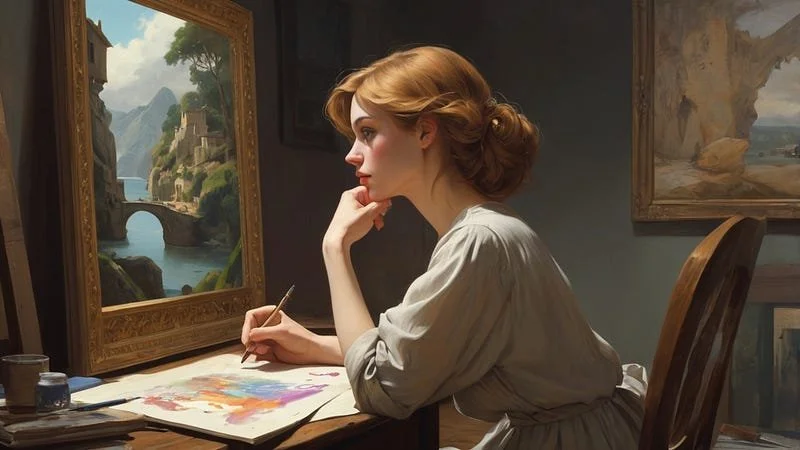
Writing Inspired by Art
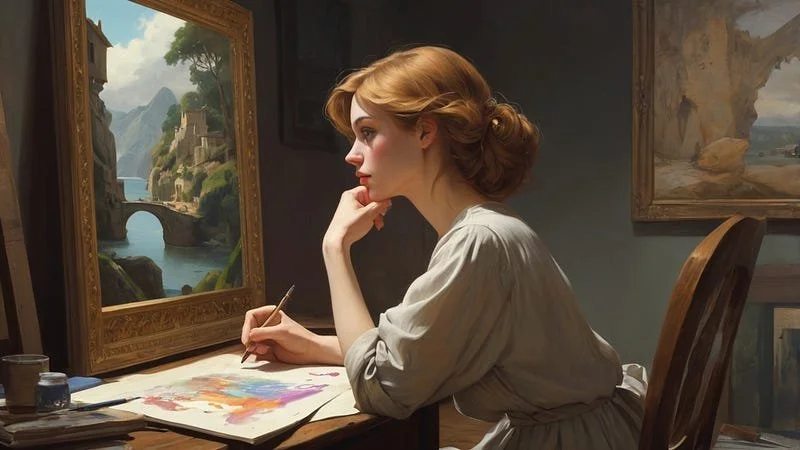
Have you ever stood before a painting and felt a poem rising in your chest? That’s the essence of ekphrastic POETRY. writing that responds to a work of visual art. It’s a creative conversation between two mediums, where a poem brings new life to a sculpture, photograph, painting, or even a film still. At its core, ekphrasis is about slowing down, observing deeply, and translating what you see into what you feel.
What Is Ekphrastic Poetry?
The word ekphrasis comes from the Greek “ek” (out) and “phrasis” (speak). it literally means “to speak out.” In literature, it refers to a vivid description of a visual work of art. But in poetry, it often goes beyond description: it interprets, imagines, and reimagines.
Famous examples date back to Homer’s description of Achilles’ shield in The Iliad, but the form is alive and thriving today in contemporary poetry.
Why Write Ekphrastic Poetry?
Fresh Inspiration: Sometimes the muse needs a nudge. Art can spark surprising metaphors or emotions you didn’t expect.
Close Observation: Writing about art slows you down and sharpens your attention to detail.
Emotional Dialogue: Ekphrasis isn’t just about what the artwork looks like, it’s about what it makes you feel, remember, or imagine.
Creative Constraints: Working from a visual stimulus can give you structure, direction, and focus.
Examples of Ekphrastic Poetry
1. W.H. Auden — “Musée des Beaux Arts”
Inspired by Bruegel’s Landscape with the Fall of Icarus, this poem reflects on how life continues even when tragedy occurs.
“About suffering they were never wrong, The Old Masters: how well they understood Its human position…”
2. Natasha Trethewey — “Photograph: Ice Storm, 1971”
This poem responds to a haunting photo of the poet as a child, exploring race, memory, and the meaning of a moment frozen in time.
3. Rainer Maria Rilke — “Archaic Torso of Apollo”
Looking at a broken statue, Rilke ends with the unforgettable line: “You must change your life.” That’s the power of art.
How to Write an Ekphrastic Poem
Step 1: Choose Your Artwork
Pick something that moves you. It could be a famous painting like Van Gogh’s Starry Night, a photograph from your family album, or even a sculpture in your local park.
Step 2: Look Closely
Spend time with the piece. Notice the colors, lines, shadows, emotions, and any narrative implied. Ask:
What’s happening in this image?
What emotions does it stir?
What stories could it hold?
Step 3: Let Emotion Lead
Don’t just describe; react. What memories or questions rise up as you look? Let your own story thread into the scene.
Step 4: Write Freely
You can write:
From the perspective of someone in the painting.
As a letter to the artist.
As a scene that continues or reinterprets the artwork.
Step 5: Revise and Refine
Shape your poem. Does it flow? Does it honor both your voice and the spirit of the artwork?
Poetry Prompt: Ekphrasis in Action
Choose one of these artworks (or select your own), and write a poem that responds to it:
The Persistence of Memory by Salvador Dalí
Girl with a Pearl Earring by Vermeer
A personal photo that evokes strong emotion or mystery.
A sculpture or mural in your town.
A black-and-white photo from a history archive.
Optional Structure Challenge:
Write your ekphrastic poem in one of the following forms:
Pantoum — For a meditative, looping feel.
Sonnet — To capture classical beauty or tension.
Free verse — To explore the emotional layers without restraint.
Final Thoughts
Ekphrastic poetry is an act of translation, from image to language, from silence to sound. It deepens your engagement with both art and language. More than that, it invites your voice into a centuries-old conversation between artists and poets.
“Art enables us to find ourselves and lose ourselves at the same time.” — Thomas Merton
So go to a gallery, open a book of photographs, or scroll through your PHONE, AND let your next poem be a mirror held up to art itself.
LEt ME know your thoughts below.
Awaken The Page
Writing Through the Senses: Deepening Poetry with Sensory Language
One of the most powerful tools in a poet’s toolbox is the ability to make a reader feel — not just emotionally, but physically. Sensory language helps your audience experience a poem with their whole body. It grounds the abstract in the tangible and transforms ordinary moments into immersive ones.
When we write through the senses, we invite the reader into the space we’re creating — into the rain-soaked street, the kitchen filled with cinnamon and regret, the sting of cold air on bare skin. This isn’t just about vivid DESCRIPTION, IT’S about awakening the reader’s inner world through texture, sound, scent, and more.
The Five Core Senses in Poetry
Let’s explore each of the five senses with examples and prompts to get your words flowing.
1. Sight (Visual Imagery)
Our strongest sense is often our DEFAULT, but even here, poetry can sharpen the lens.
Example:
The horizon bruised purple behind the church steeple, windows blinking orange in farewell.
Notice how “bruised purple” adds an emotional undertone, suggesting not just color but mood.
Prompt:
Describe a place at dusk using only visual imagery — no emotion words, just what can be seen.
2. Sound (Auditory Imagery)
Sound adds rhythm and MOOD; THINK footsteps, birdsong, or even silence.
Example:
The clack of spoons in coffee mugs, the radio mumbling a Motown tune while thunder paced the porch outside.
Prompt:
Write about a memory you associate with a particular sound — how does it shape your emotion in that moment?
3. Touch (Tactile Imagery)
Texture, temperature, pressure, all convey intimacy and emotion.
Example:
I pressed my cheek to the cold tile floor, the grout biting like winter’s edge as the ache settled in my bones.
Prompt:
Use touch to describe grief, love, or safety. How does the body register feeling?
4. Taste (Gustatory Imagery)
Taste is deeply connected to memory and emotion. A single flavor can unlock a poem.
Example:
The lemon tart stung the tip of my tongue; sharp, like the first truth I spoke aloud.
Prompt:
Write a poem centered on a specific food or drink. What emotion does it hold or release?
5. Smell (Olfactory Imagery)
Scent is one of the most direct links to memory, often surprising and nostalgic.
Example:
Dust and dried roses curled through the air like old piano SONGS, GRANDMA’S house before the silence.
Prompt:
Use smell to recall a place or person who is gone. Let scent lead the story.
Putting It All Together: A Sensory Poem
Here’s a short poem that weaves all five senses:
Winter Morning Breath fogs the window in slow exhale (sight) as kettle steam keens a soft whistle (sound). Wool sleeves itch against my skin (touch), toast cracks under a smear of butter, the bitter coffee biting sweet crumbs (taste). Somewhere beneath it all, the faint scent of woodsmoke and pine (smell), and the memory of her voice saying, “You’re safe.”
Tips for Writing Sensory-Rich Poetry
Start with a moment: Focus on one concrete memory or experience.
Write with your body: Imagine yourself in the moment. What do you feel?
Avoid clichés: “Soft as a feather” is FAMILIAR; try “soft like river fog in morning light.”
Layer your senses: Don’t OVERLOAD BUT explore how two or more senses overlap in a scene.
Final Prompt: The Five-Senses Memory Map
Choose a specific place or moment in your life (a first kiss, a kitchen, a goodbye, a childhood room). Write one line for each of the five senses to describe it. Then expand those lines into a full poem.
Closing Thought
Poetry is not just what we SAY; IT’S what we invite others to feel. When you write through the senses, you’re not just building a scene, you’re crafting an experience. The more physical and real your world becomes, the deeper your readers will fall into it.
Let me know your thoughts below.